
Northstar Labs turns fragmented inbound demand into one qualified pipeline
Northstar Labs is a mid-market B2B software company receiving inquiries from its website, events, partner referrals and paid campaigns. As the team expanded across regions, lead quality, ownership and response time became difficult to manage consistently.
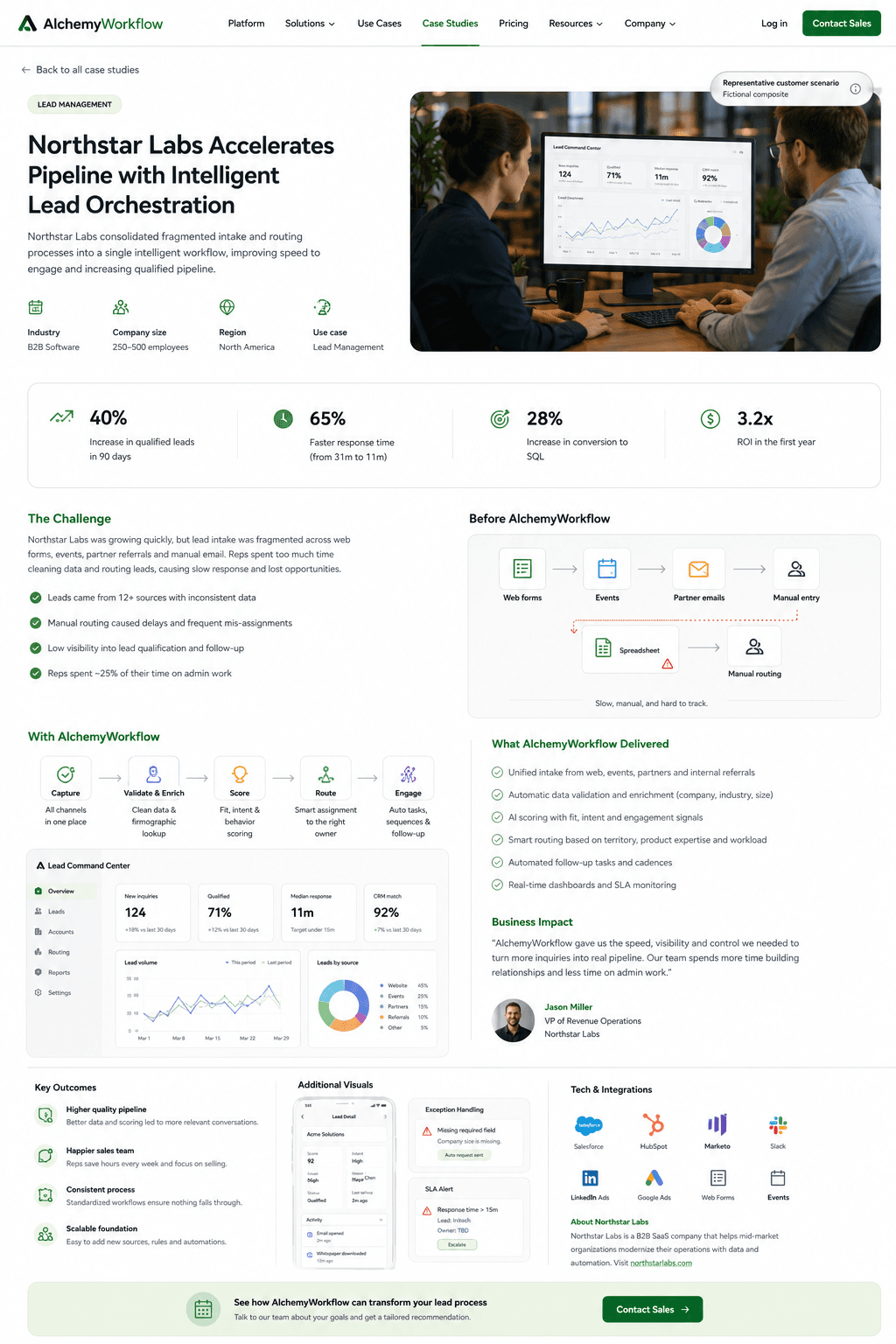 Representative customer scenario · Fictional composite
This case study is a fictional composite based on common workflow automation patterns. The organization, quotation and results are illustrative and are not presented as a verified customer endorsement.
Why the existing operating model could not scale
Northstar Labs is a mid-market B2B software company receiving inquiries from its website, events, partner referrals and paid campaigns. As the team expanded across regions, lead quality, ownership and response time became difficult to manage consistently.
- Lead records arrived with different field names, consent formats and campaign metadata.
- Marketing operations manually cleaned records and searched the CRM for existing accounts.
- Territory, segment and product rules were maintained in spreadsheets and individual memory.
- High-intent inquiries could remain in a shared queue without an accountable owner.
- Sales leadership lacked a single view of qualification, routing exceptions and response SLA.
Work moved through disconnected tools and informal handoffs.
Website forms, webinar exports and partner emails created separate intake queues.
CRM records were created before the team knew whether an account already existed.
Lead scoring focused on form fields but ignored account ownership and recent engagement.
Follow-up tasks were created inconsistently, and escalation depended on a manager noticing the delay.
One governed path from intake to completion.
The implementation connects the systems already in use, standardizes decisions and preserves a human review point wherever business judgment is required.
Capture and normalize
Receive the source, campaign, consent, contact and company fields in a standard inquiry record.
Match the account
Compare domain, company name and known identifiers with CRM accounts before creating a new record.
Enrich and qualify
Add approved company context and apply fit, geography, product-interest and intent rules.
Route to the owner
Assign the inquiry using territory, named-account ownership, product expertise and workload.
Coordinate follow-up
Create CRM tasks, notify the owner and escalate inquiries that remain untouched beyond the response target.
Measure the lifecycle
Track qualification decisions, routing exceptions, owner acceptance and inquiry-to-opportunity progression.
Automation remains visible, reviewable and owned.
Each control is assigned to a business or system owner during implementation and documented in the SOW.
Human qualification review
Borderline or incomplete inquiries enter an operator queue rather than being automatically rejected.
Duplicate prevention
Account matching runs before record creation, with uncertain matches requiring confirmation.
Consent preservation
Original source and consent attributes remain attached to the inquiry throughout downstream actions.
Routing overrides
Authorized managers can reassign ownership and record the reason without editing the core workflow.
SLA escalation
Unworked inquiries generate reminders and move to a manager queue after the agreed threshold.
Audit history
Each decision, owner change and downstream CRM action is retained in the execution record.
A phased implementation designed around production readiness.
Map intake sources
Inventory fields, owners, consent requirements and current routing rules.
Phase 1Launch one region
Connect the primary web form and CRM, then test with a limited sales team.
Phase 2Add channels and rules
Bring in events, partners and paid campaigns after the pilot stabilizes.
Phase 3Tune decisions
Review false matches, routing exceptions and conversion patterns each month.
Phase 4What the team should be able to measure after launch.
- Median time from inquiry submission to named owner.
- Percentage of inquiries matched to an existing CRM account.
- Qualification rate by source, campaign and region.
- Routing exception volume and reassignment reasons.
- Inquiries breaching the response SLA.
- Conversion from inquiry to sales-qualified opportunity.
“The real improvement is not just speed. Marketing and sales now see the same record, the same qualification decision and the same owner. We spend less time reconciling what happened and more time following up.
What comes next after the first workflow is stable.
- 01Add account-based routing for named strategic accounts.
- 02Introduce nurture workflows for inquiries that are not yet sales-ready.
- 03Connect product usage and event attendance as additional intent signals.
- 04Create executive dashboards for source quality, response SLA and pipeline contribution.
We will map the systems, owners and failure points.
Start with one workflow and a scoped implementation plan.
Talk to our solutions team