
Arcway Commerce gives every escalation an owner, an SLA and a resolution path
Arcway Commerce supports enterprise customers across billing, integrations, service operations and account management. Requests entered through multiple channels, and complex cases frequently crossed team boundaries before reaching a specialist.
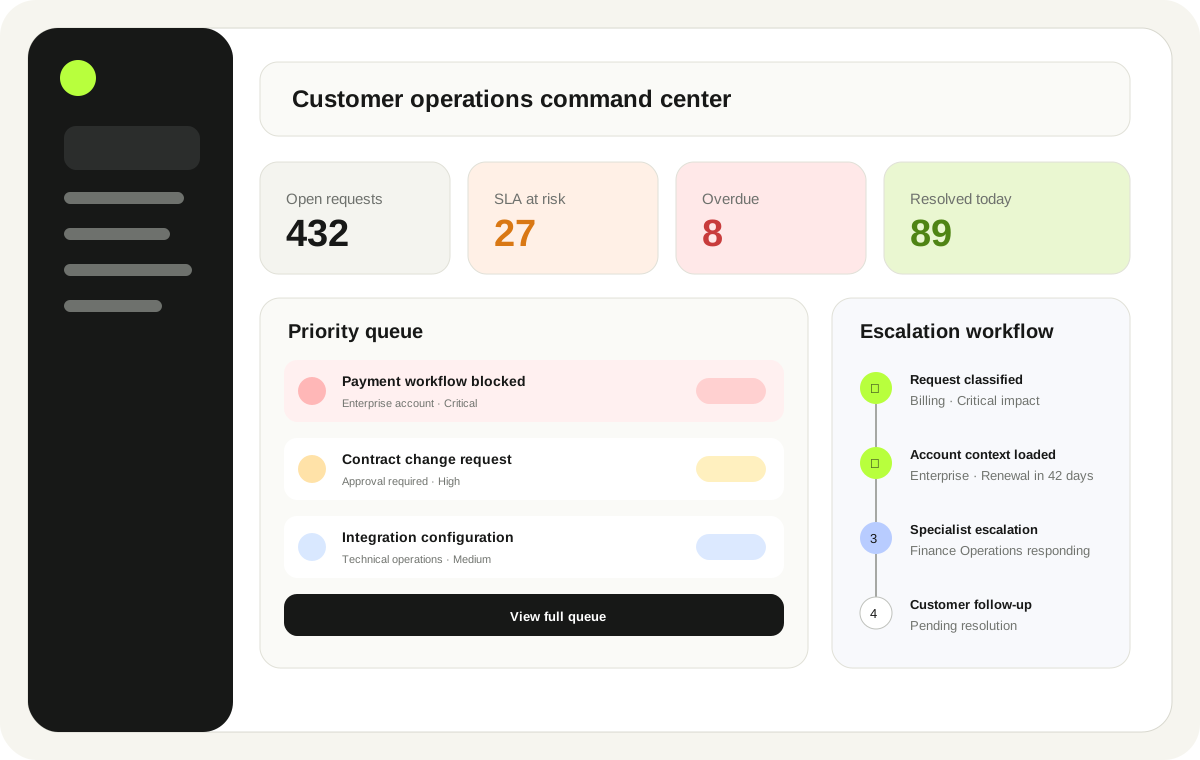 Representative customer scenario · Fictional composite
This case study is a fictional composite based on common workflow automation patterns. The organization, quotation and results are illustrative and are not presented as a verified customer endorsement.
Why the existing operating model could not scale
Arcway Commerce supports enterprise customers across billing, integrations, service operations and account management. Requests entered through multiple channels, and complex cases frequently crossed team boundaries before reaching a specialist.
- Support forms, account-team emails and internal messages created separate request paths.
- Priority was interpreted differently across support, customer success and billing teams.
- Specialists received escalations without complete account, contract or issue context.
- Customers could receive updates from multiple teams without a single resolution owner.
- Leadership could not reliably distinguish active risk, overdue work and blocked dependencies.
Work moved through disconnected tools and informal handoffs.
Urgent requests were mixed with ordinary service questions in shared queues.
Escalation relied on manual forwarding and individual knowledge of the organization.
Billing, technical and customer-success teams kept separate notes and status updates.
SLA commitments were not consistently connected to customer tier, issue impact and current ownership.
One governed path from intake to completion.
The implementation connects the systems already in use, standardizes decisions and preserves a human review point wherever business judgment is required.
Capture the request
Combine channel, account, issue, customer tier, current impact and supporting evidence.
Classify and prioritize
Apply category, severity and SLA rules while allowing trained operators to correct the result.
Load customer context
Retrieve account owner, contract tier, open risks and related cases before routing.
Assign the resolution owner
Route to the appropriate specialist and preserve one accountable owner across handoffs.
Escalate by policy
Notify managers, account teams or executives when severity or elapsed time crosses a threshold.
Close and follow up
Record the resolution, update connected systems and coordinate the customer-facing response.
Automation remains visible, reviewable and owned.
Each control is assigned to a business or system owner during implementation and documented in the SOW.
Priority override
Operators can correct severity with a required reason and preserved audit history.
Single active owner
The workflow always identifies the person accountable for next action, even when multiple teams contribute.
SLA calculation
Target times are derived from customer tier, impact and issue category.
Sensitive action approval
Refunds, credits or contract changes require an authorized reviewer.
Customer communication gate
External updates use approved resolution context rather than raw internal notes.
Closure validation
A request cannot close until required actions, customer communication and system updates are complete.
A phased implementation designed around production readiness.
Define request classes
Map channels, categories, SLAs, owners and current escalation policies.
Phase 1Start with one queue
Implement the highest-volume request category and a defined specialist group.
Phase 2Add cross-team cases
Connect billing, technical operations and account-management escalation paths.
Phase 3Review SLA health
Analyze misclassification, reassignment, aging work and recurring root causes.
Phase 4What the team should be able to measure after launch.
- Time from request receipt to an accountable owner.
- Percentage of requests handled within the applicable SLA.
- Reassignment volume and reasons.
- Requests waiting on approval, customer input or another team.
- Escalation frequency by account tier and issue category.
- Repeat-request rate after resolution.
“The biggest change is clarity. Everyone can see who owns the next action, why a request is urgent and what must happen before the customer receives an update.
What comes next after the first workflow is stable.
- 01Add proactive workflows for recurring integration and billing risks.
- 02Connect account-health indicators to escalation priority.
- 03Introduce post-resolution review for high-impact incidents.
- 04Create executive reporting for SLA risk, root causes and customer impact.
We will map the systems, owners and failure points.
Start with one workflow and a scoped implementation plan.
Talk to our solutions team